Judging research novelty cheaply: comparing Ai2’s benchmarks to an embedding distance metric, and a small QWEN-model (with and without reasoning).
Embedding-distance novelty metrics vs LLM-as-judge on Ai2’s new novelty benchmark

Updated 6 November 2026: I added a reasoning judge, Qwen3-4B with its thinking mode off and on. See Does reasoning help?
- The question: with no LLM at all, can distance to prior work tell which of two research ideas is more novel, on the same items Ai2 used to test LLM judges?
- Distance roughly matched a 3B judge. With the BGE-M3 embedding model, the simplest distance score picked the more novel idea in 60% of 154 human-written pairs (95% confidence interval 53% to 68%). A 3B LLM judge using Ai2’s prompts scored 55% to 58%, and the two are not significantly different. Both sit roughly halfway between chance and the frontier.
- A newer 4B model came close to the frontier. Qwen3-4B scored 69% without reasoning and 72% with it. Ai2’s six frontier judges scored 74% to 84% on the same pairs.
- Reasoning barely helped. Letting Qwen3-4B think first added 3 points, which is not significant, and made it about 27 times slower. Most of the gain came from the newer model.
- The embedding model matters as much as the metric. With the smaller bge-small model, every distance score was at chance.
- The small judges’ weakness was order, not wording. Their verdicts flipped on 45% to 87% of pairs when the two ideas swapped places.
- Mixed human and LLM-written pairs mostly measure who wrote the idea, for distance and judges alike, with or without reasoning.
Why I ran this
Research agents can now generate ideas faster than anyone can read them, so something has to filter them, and novelty is one of the first filters people reach for. The usual tool is an LLM judge: give a model the idea and ask whether it is new.
In October 2026, Ai2 published Old Ideas, Novel Problems, a benchmark built to test exactly those judges. Its findings were not encouraging. Rewording the prompt moved pairwise accuracy by more than 50 points for some judges, giving the judge related papers barely helped, and two purpose-built novelty systems lost to a plainly prompted model. The study cost about $15,000 in API calls, and every condition in it is an LLM.
There is an older and much cheaper way to score novelty: embed the idea and measure how far it sits from everything published before. Liu and Zhai’s axiomatic benchmark (2026) found the simplest version of this, Yin et al.’s minimum distance, the strongest of ten novelty systems on their tests, but on different data.
Before building anything, I read Ai2’s paper looking for an embedding baseline. There isn’t one: no similarity score, no nearest-neighbour baseline, nothing that scores novelty without an LLM. So the question was open: on Ai2’s own items, how close does plain distance get to an LLM judge? These metrics aren’t new but the comparison is.
The benchmark
Ai2 mined ICLR 2026 reviews for comments that explicitly praised or faulted a submission’s originality. From the top and bottom rating deciles of each research area, that gave 154 submissions reviewers called original and 145 they called unoriginal. Ai2 rewrote each abstract with Claude Opus 4.6 to strip out results, so that a judge sees the idea rather than the numbers.
The benchmark comes in two formats:
- Pairwise: two ideas, one praised and one faulted. Which is more novel? Scored by accuracy, where chance is 50%.
- Pointwise: one idea. Does it clear ICLR’s bar for novelty? Scored by macro-F1.
And two splits. Human-Only pairs human ideas with human ideas, and it is the one I treat as the main result. Human+Generated pairs each praised human idea with one written by a plainly prompted Claude Sonnet 4.5. Ai2 describes those labels as weaker, and as you’ll see, that split turned out to measure something else entirely.
Two ways to score novelty
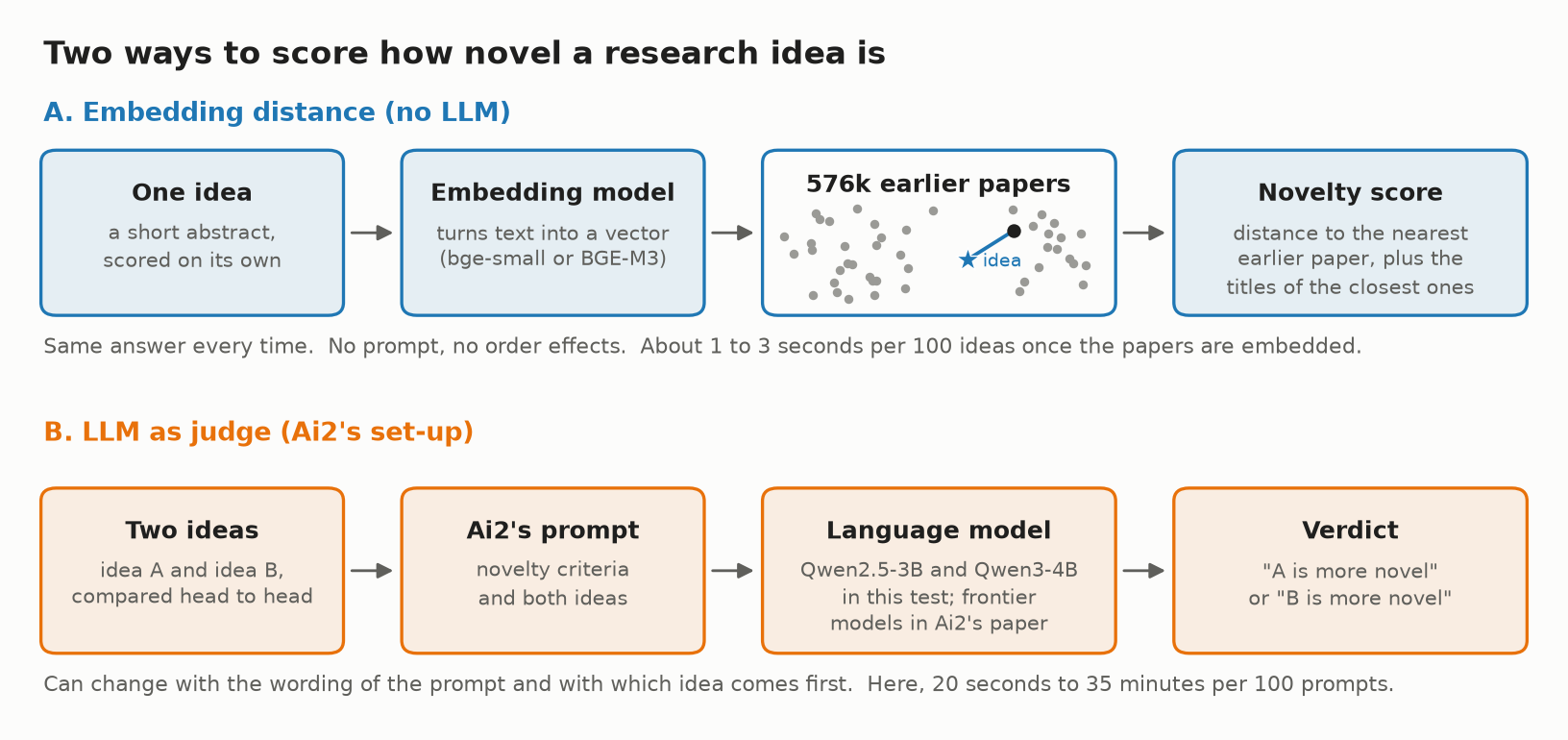
Embedding distance scores one idea at a time. An embedding model turns the idea’s abstract into a vector, and the score depends on how close that vector is to the nearest of 576,000 earlier papers. I tested three versions, from simplest to most involved:
- Yin: one minus the cosine similarity to the single nearest paper (Yin et al., 2023, PLOS ONE). Far from everything means novel.
- kNN density: the same, averaged over the 10 nearest papers, so one lucky near-miss counts for less.
- RND: relative neighbour density (Wang et al., 2025). It compares how crowded the idea’s neighbourhood is with how crowded its neighbours’ own neighbourhoods are, which is meant to correct for some fields simply being denser than others.
An LLM judge reads both ideas inside Ai2’s prompt, which spells out what counts as novel, and says which one is more novel. It brings its own knowledge of the field from training, but not a list of papers it can point to.
The practical differences matter as much as accuracy. Distance gives the same answer every time and comes with evidence: the titles of the closest papers, which anyone can check. A judge compares the two ideas directly, which is closer to what a reviewer does, but it can change its answer with the wording of the prompt or with which idea it reads first.
Setup
| Benchmark | allenai/novelty-judge-bench (ODC-BY), pinned to one revision: 154 pairs per split, plus single-idea versions |
| Prior work | 576k ML papers with abstracts from the Papers with Code archive (CC BY-SA 4.0), which stops in July 2025, two months before the ICLR 2026 deadline |
| Embedding models | bge-small-en-v1.5 (33M parameters, 2023) and BGE-M3 (568M parameters, 2024, the model Liu and Zhai used) |
| Judges | Qwen2.5-3B-Instruct (September 2024), on Ai2’s reference prompt and two of its prompt variants: vague criteria and no criteria. Qwen3-4B (April 2025), on the reference prompt with its thinking mode off and on. The prompts are loaded from Ai2’s own code at a pinned commit. |
| Metrics | Ai2’s metrics, plus 95% bootstrap confidence intervals, exact McNemar tests between conditions on the same pairs, and AUROC |
| Hardware | One free Colab T4 GPU. The main run takes about two hours, most of it embedding the corpus. Qwen3-4B with thinking on adds about 3.5 hours. |
Every model was released before the ICLR 2026 deadline, and well before the reviews that supply the labels.
The leakage filter
Many ICLR submissions were on arXiv months before the deadline. A naive search would find each idea’s own preprint, measure a distance of nearly zero, and call it unoriginal. So any paper matching an idea’s OpenReview ID or title, or with cosine similarity of 0.95 or more, was dropped from that idea’s neighbours and logged.
That removed 31 matching preprints by ID or title, and 24 near-copies by similarity. Most near-copies were obviously the same work under a new title, such as “Image Quality Assessment for Embodied AI” and “Perceptual Quality Assessment for Embodied AI” at 0.999. A few at the threshold were genuinely different earlier papers, so the filter leans towards removing too much rather than too little.
The judges, run cheaply
Ai2’s judges reason at length and pool three samples per verdict. For the 3B judge, I read the verdict straight from the model’s probabilities for “0” and “1” after an empty reasoning block, which is fast and deterministic. Qwen3-4B was read the same way, once with its reasoning block left empty and once after it had written its reasoning there. I ran every pair in both orders and averaged the two probabilities, for a reason that becomes clear below.
Results: which of two ideas is more novel?
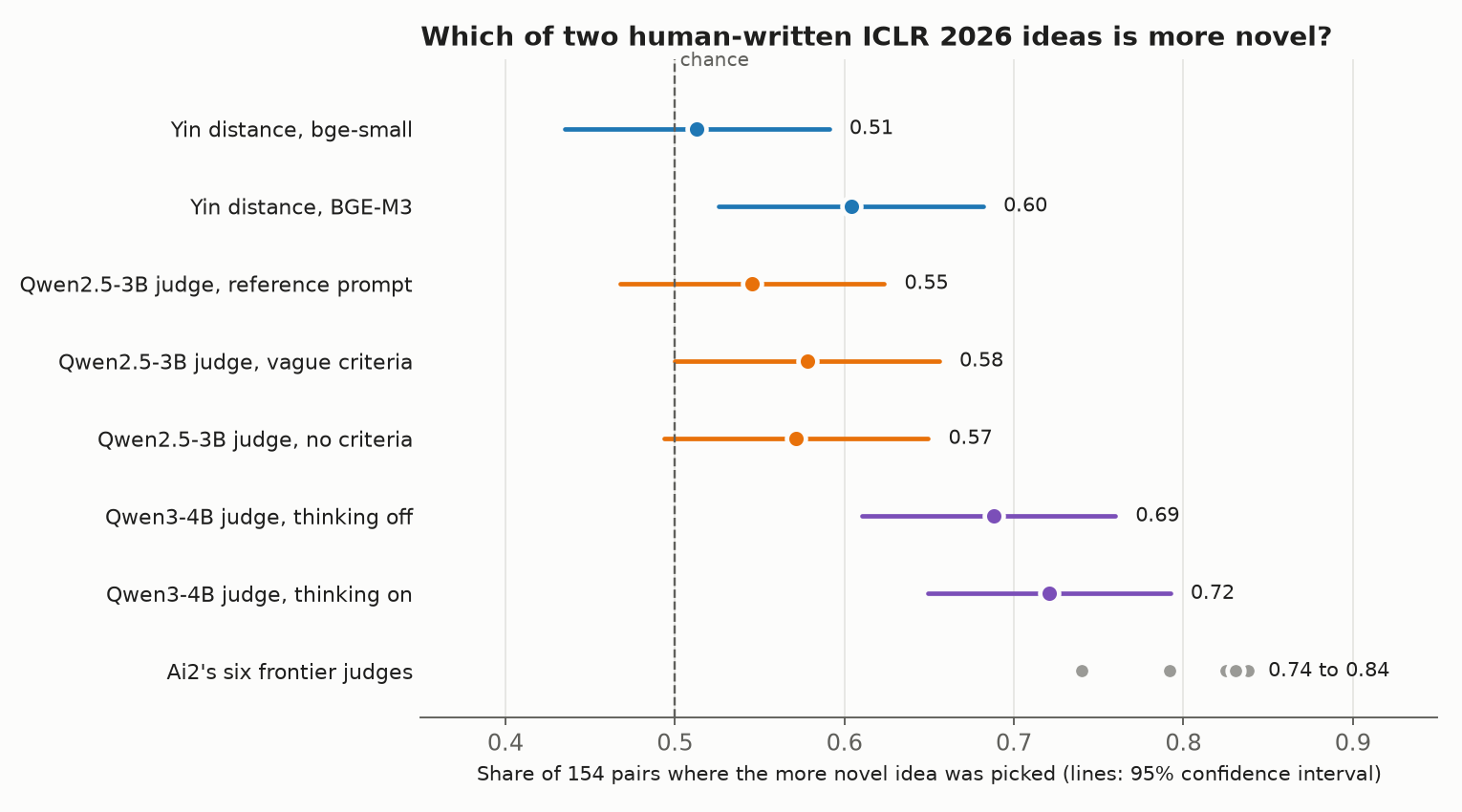
With BGE-M3, Yin’s distance picked the more novel idea 60% of the time. The 3B judge scored 55% to 58% across the three prompts. On the pairs where one was right and the other wrong, neither won significantly (McNemar p = 0.33 to 0.71), and the 3B judge was not significantly above chance with any prompt.
Qwen3-4B was a different story: 69% with thinking off and 72% with it on. With thinking on, it beat the 3B judge on the same prompt (38 pairs against 11, p < 0.001) and BGE-M3 distance (37 against 19, p = 0.022). Ai2’s frontier judges (Claude Sonnet 4.5, Opus 4.5 and 4.6, GPT-5.1, 5.2 and 5.4) scored 74% to 84%, so a 4B model on a free GPU landed 2 points behind the weakest of them and 12 behind the best.
All three distance metrics on the Human-Only pairs:
| Metric | bge-small | BGE-M3 |
|---|---|---|
| Yin (nearest paper) | 51% | 60% |
| kNN density (10 nearest) | 49% | 58% |
| RND | 57% | 55% |
With BGE-M3, the ranking matches Liu and Zhai’s: the simplest metric wins. Combining BGE-M3 distance with the 3B judge in a cross-validated regression added nothing (60% either way).
A caveat on that 60%: I tested six embedding conditions per split, and after a Bonferroni correction for that (p below 0.008), none clears the bar. The uncorrected p-value is 0.012. I’d thus call it suggestive, not shown.
Does reasoning help?
Ai2’s judges think before they answer; the 3B judge never did. Qwen3-4B is a hybrid model, trained to work with its thinking mode either on or off, so the same model with the same prompt can be run both ways. With thinking on, it wrote a median of about 840 tokens of reasoning before each verdict, typically summarising both ideas, going through Ai2’s criteria one by one and then picking a side.
| Qwen3-4B, reference prompt | Human-Only accuracy | 95% CI | Order flips | Time per 100 prompts |
|---|---|---|---|---|
| Thinking off | 69% | 61% to 76% | 64% | about 80 seconds |
| Thinking on | 72% | 65% to 79% | 45% | about 35 minutes |
Reasoning added 3 points. Thinking on got 13 pairs right that thinking off got wrong, against 8 the other way (p = 0.38), so on these pairs the gain is within noise, at about 27 times the cost. The bigger jump came from the model itself: even with thinking off, Qwen3-4B scored 14 points above the 3B judge on the same prompt.
Three things in the reasoning traces are worth knowing before you rely on that 72%:
- It still prefers the second idea. With thinking on, it picked the second idea 72% of the time. It was right on 88% of prompts when the more novel idea came second, and on only 44% when it came first. Averaging both orders is what gets it to 72%; in a single order it scored 66%.
- Long reasoning went with wrong answers. I capped reasoning at 1,024 tokens, and a third of the traces hit the cap. Those were at chance (50%), against 74% for traces that finished. Accuracy fell steadily with length: 78% for the shortest third and 51% for the longest. That could mean the cap was too tight, or that hard pairs simply make the model think longer. This run can’t tell those apart.
- No sign that it had seen the papers. Qwen3’s training data reportedly runs to about March 2025, by which time some submissions were on arXiv. Accuracy was the same whether or not a pair included an idea with a preprint in my corpus (65% and 66%). That is a weak check, but the labels come from reviews written months after the model was released, so it can’t have seen those.
The embedding model matters as much as the metric
I added BGE-M3 after the first run, because I wanted to know whether a weak result was down to a small embedding model. It was, partly. With bge-small, all three distance scores were at chance on Human-Only. BGE-M3 got 28 pairs right that bge-small got wrong, against 14 the other way (p = 0.044).
More striking was how much the two models disagree about what counts as nearby. Their Yin scores correlate at only 0.64, and they picked the same nearest paper for just 19% of ideas.
So a distance score isn’t free of configuration choices. For a judge, the prompt is the setting that can quietly change the answer. For distance, it’s the embedding model.
The judges’ weakness was order, not wording
Ai2’s headline finding was prompt sensitivity, so I ran the 3B judge on three of their prompts. Wording barely moved it:
| Judge | Spread across the three prompts, Human-Only | Spread, Human+Generated |
|---|---|---|
| Qwen2.5-3B (this test) | 3 points | 8 points |
| Ai2’s six frontier judges | 1 to 10 points | 6 to 21 points |
On these three prompts, the small judge is about as stable as the frontier ones. Ai2’s swings of more than 50 points come from other prompt variants that I didn’t run.
Order was the real problem. When I swapped which idea came first, the 3B judge’s verdict flipped on 87% of Human-Only pairs with the reference prompt, and on 53% to 61% with the other two. Most of the time it was picking a position, not an idea. Qwen3-4B was better but far from immune: 64% with thinking off and 45% with it on, and some of that 45% is just sampling noise, since each order got one sample. Averaging both orders cancels position bias out, which is why I ran every pair twice. If you use a small model as a pairwise judge, I’d treat order-swapping as mandatory.
What distance gets right, and what it can’t see
Two pairs from the results show both sides.
Where distance was right and the judge wrong. “LLM Pretraining with Continuous Concepts” (praised by reviewers) against “InfiMed-Foundation”, a medical multimodal model (faulted). The nearest earlier paper to InfiMed-Foundation was “Infi-Med: Low-Resource Medical MLLMs with Robust Reasoning Evaluation”, which appears to be earlier work from the same project. Distance saw that closeness straight away, and the 3B judge leaned the other way.
Where both were wrong. “Lipschitz Bandits with Stochastic Delayed Feedback” (praised) sat very close to “Delayed Feedback in Generalised Linear Bandits Revisited”, so distance rated it unoriginal. But a new combination of known ingredients can be exactly what reviewers call novel, which is close to the point of Ai2’s title. Distance can tell you an idea is near existing work. It can’t tell you whether the step it takes is a meaningful one.
Mixed human and LLM pairs measure authorship
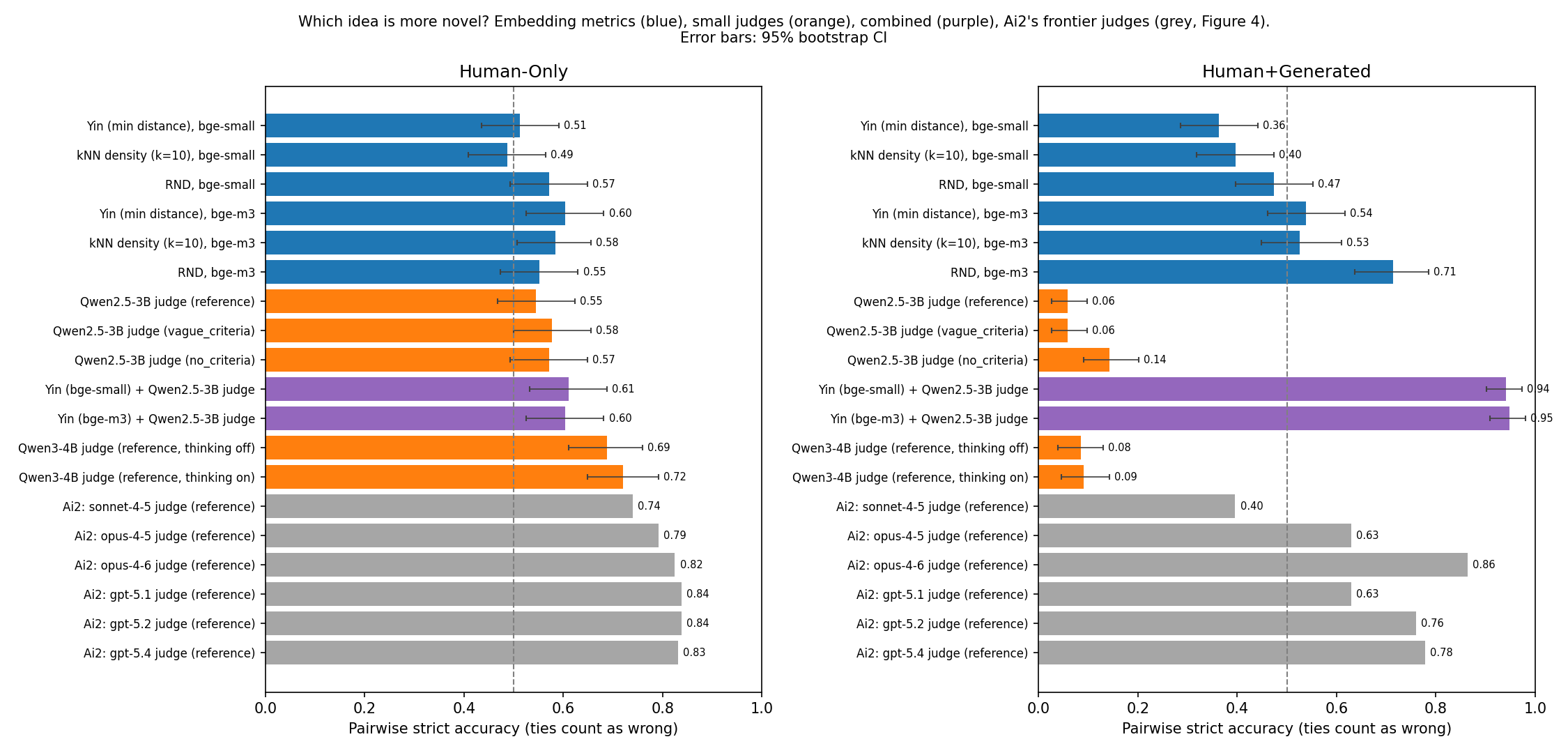
On Human+Generated, every pair sets a praised human idea against one written by Claude Sonnet 4.5. The numbers on the right of the chart look wild, and none of them should be read as novelty accuracy:
- Both small judges preferred the LLM-written idea. The 3B judge did so 94% of the time. Qwen3-4B scored 8% to 9%, and reasoning didn’t change that. Ai2’s own Sonnet 4.5 judge, the model that wrote those ideas, picked the human idea in only 40% of pairs.
- bge-small distance rated the LLM-written idea as more novel in 64% of pairs, which put it below chance.
- BGE-M3’s RND scored 71%, which looks impressive until you see it reaches only 55% when both ideas are human. It ranked the LLM-written idea lower in 73% of pairs, so it is most likely picking up LLM writing rather than novelty.
- Combining distance with the 3B judge reached 95%, because the regression learned to flip a judge that was reliably wrong. That is not the two scores agreeing.
If you want to compare human and LLM-generated ideas for novelty, this is the warning: every method here reacts to who wrote the text.
Is any score measuring quality instead?
The two groups come from opposite ends of the rating distribution, so a score could separate them by tracking how good a paper is rather than how new. Within a group, every idea has the same novelty label, so a strong link to rating there would point to quality. There wasn’t one: no score correlated with reviewer rating beyond 0.14 within either group, and none significantly. Ratings within a group span a narrow range, which limits this check, and it doesn’t cover Qwen3-4B, which I ran on pairs only.
Single ideas and cost
On single ideas, the 3B judge did better than distance: AUROC 0.64 to 0.68 across its prompts, against 0.57 for BGE-M3 Yin and at most 0.59 for any distance score. It also said “novel” to almost every idea, so with Ai2’s plain 50% cut-off its macro-F1 was only 0.35 to 0.40. The signal was there, but only in tiny differences near the top of the scale. Ai2’s frontier judges, giving yes or no verdicts, reached 0.61 to 0.81.
| Time on a T4 | Notes | |
|---|---|---|
| Distance, bge-small | about 1 second per 100 ideas | after a one-off embedding of the corpus |
| Distance, BGE-M3 | about 3 seconds per 100 ideas | after a one-off embedding of the corpus |
| Qwen2.5-3B judge | 20 to 40 seconds per 100 ideas | depending on prompt length |
| Qwen3-4B, thinking off | about 80 seconds per 100 pair prompts | |
| Qwen3-4B, thinking on | about 35 minutes per 100 pair prompts | 3.5 hours for both splits |
| Ai2’s frontier judges | API fees | about $15,000 for Ai2’s whole study |
When I’d use distance, and when I wouldn’t
I’d use it as a cheap first pass. It is repeatable and fast, and the nearest titles give a reviewer or a stronger judge something concrete to check. That makes it good for flagging ideas that sit very close to existing work, and for supplying related papers to a better judge.
I wouldn’t use it to rank ideas on its own. Frontier judges are 14 to 24 points ahead, and a 4B open model on the same free GPU is 8 to 12 points ahead. I also wouldn’t use it to compare human and LLM-written ideas, or trust one embedding model’s verdict without trying a second.
If I wanted a cheap local judge, I’d start with a recent small model, without reasoning, run in both orders. Qwen3-4B with thinking off finished about 5 points behind the weakest frontier judge for 80 seconds per 100 prompts. Reasoning bought 3 points that might not be real, for 35 minutes per 100.
Limitations
- 154 pairs per split. Each accuracy has a confidence interval of about 8 points either side, and with this many conditions, some results below p = 0.05 are expected by chance.
- The judges are not run the way Ai2 ran theirs. The verdicts come from probabilities rather than written answers. Qwen3-4B sampled its reasoning once per order and was capped at 1,024 tokens, while Ai2’s judges reason at length and pool three samples. A third of Qwen3’s traces hit the cap, so a longer budget might change its with-reasoning score.
- One corpus snapshot. Papers with Code ends in July 2025 and leans towards papers with code and benchmarks, so recent or theory-heavy prior work is missing, which makes some ideas look more novel than they are.
- The leakage filter is a blunt tool. A heavily rewritten preprint below 0.95 still counts as prior work against its own idea, and a few genuinely earlier papers above it were removed.
- Rewritten ideas, raw corpus. The benchmark ideas are abstracts Ai2 rewrote with Claude Opus 4.6 to strip out results, while the corpus holds original abstracts. For the 31 ideas whose original is in the corpus, the rewrite moved each text far less than the distance to its nearest other paper: median cosine to its own original was 0.99 with bge-small and 0.98 with BGE-M3, against 0.91 and 0.77 to the nearest other paper. A shift shared by all ideas cancels out in pairs, but the part that varies from idea to idea adds noise unrelated to novelty, and may be part of why distance tops out around 60%. BGE-M3 also put 8 of those 31 ideas below 0.95 from their own original, so its cosine threshold alone would have missed them; the ID and title check caught them. On Human+Generated, both sides are LLM text (Opus rewrites of real abstracts against ideas Sonnet 4.5 wrote from scratch), so that split’s effect is best read as real-paper ideas against generated ones, whether through content or style.
- Labels mined from reviews mix novelty with quality, and the frontier numbers are read off Ai2’s figure, not rerun.
What I’d test next
- Qwen3-4B with a longer reasoning budget, such as 2,048 tokens, to see whether the traces that hit the cap were cut short or just faced hard pairs.
- A judge given the nearest papers that distance finds, so it judges with evidence rather than memory. Ai2 found that related papers helped their judges little; this would test whether the nearest neighbours from a large corpus do any better, and Qwen3-4B makes it cheap to try.
- Ai2’s other prompt variants on the small judges, to see whether they show the same large swings.
Try it yourself
The notebook runs top to bottom on a free Colab GPU, with the corpus embeddings and judge outputs cached on Google Drive so a disconnect doesn’t lose work. No API keys are needed. The Qwen3-4B condition is off by default; one setting switches it on.
Thanks to Ai2 for the benchmark and for publishing their prompts and code, to the Papers with Code archive maintainers, and to BAAI and the Qwen team for the models.